Louisville Metro Council advances $205,000 restoration plan for vandalized King Louis XVI marble statue downtown
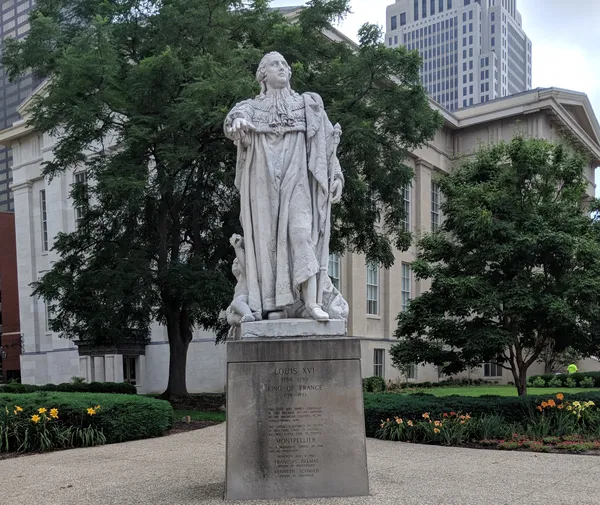
A long-stored monument moves closer to conservation work and a decision about where it will stand
Louisville Metro Council has taken a new step toward restoring the city’s large marble statue of King Louis XVI, moving forward with a plan to spend $205,000 on cleaning and conservation after years of debate over cost, ethics and public display.
The proposal advanced in early March 2026, when the Metro Council Labor and Economic Development Committee approved a resolution authorizing a noncompetitively negotiated professional services contract valued at $205,000 for conservation work on the statue. The funding had already been included in the city budget, and the resolution was expected to proceed to the full Metro Council for final action.
How the statue was damaged and why it was removed
The statue, carved from Carrara marble, is associated with Louisville’s name and long-running civic identity. It was created in the 1820s by French sculptor Achille-Joseph-Étienne Valois and later transferred to Louisville as a gift from its French sister city, Montpellier, with installation dating to the 1960s.
In 2020, during the wave of protests in Louisville centered at and around Jefferson Square Park and Metro Hall, the statue was repeatedly spray-painted. On May 28, 2020, a hand was broken off while a demonstrator climbed onto the monument. Louisville removed the statue in September 2020, citing public safety concerns and the risk of further damage, and placed it in a city-owned storage facility.
What the $205,000 restoration is intended to cover
Officials and conservation professionals have described the project as more complex than removing paint from a surface. Over time, the statue’s marble developed cracks and other deterioration, conditions attributed to exposure, age, and earlier cleaning methods. Conservation efforts have included steps to stabilize the stone and reattach broken elements, including the damaged hand.
The newly approved contract framework focuses on cleaning and treating the statue’s surface and addressing remaining graffiti, while continuing conservation work suitable for porous, aging marble. City officials have also discussed the restoration timeline in connection with major civic milestones, including Louisville’s 250th anniversary in 2028.
Unresolved questions: ethics, priorities, and placement
The plan has drawn competing arguments inside Louisville government and among arts stakeholders. Some conservators have raised concerns that removing protest-era graffiti can be ethically fraught when markings are tied to a significant local historical moment. Others have argued the city should restore damaged public property and return the statue to public view.
Another practical issue remains unresolved: where the statue should ultimately be displayed. Prior discussions included the possibility of returning it outdoors near its former site at Sixth and Jefferson, as well as relocating it indoors to reduce environmental damage and limit future conservation costs.
- $205,000 in city funding has been set aside for cleaning and treatment.
- The statue has been in storage since September 2020 after repeated vandalism and structural damage.
- A final decision on permanent placement is still pending.
The current action positions the city to begin or continue professional conservation work, while leaving the broader question—how Louisville should present this artifact of its namesake and its recent protest history—still open.