Downtown Louisville intersection shifts from traffic lights to stop signs amid broader corridor redesign trial
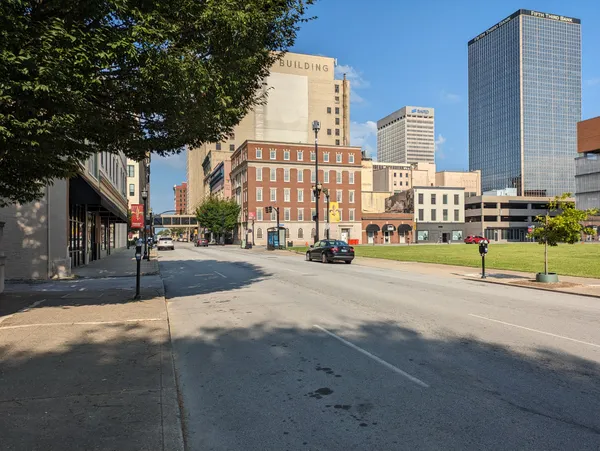
Traffic control change introduced as part of downtown-to-West Louisville street conversion work
Drivers traveling through parts of downtown Louisville and the westward corridor are encountering a notable change: at selected intersections, traditional traffic signals have been replaced by stop signs after a period of operating in flashing-red mode. The change is tied to ongoing work that will convert key one-way streets back to two-way traffic as part of Louisville Metro’s Reimagine 9th Street initiative.
The most prominent near-term change affects Muhammad Ali Boulevard at 7th Street and 8th Street, where motorists now stop at signs rather than proceed through signal-controlled intersections. The shift is framed as a trial period, during which traffic engineers will assess how the new controls affect operations and safety.
Where stop signs are being used, and how long the trial lasts
Along sections of Muhammad Ali Boulevard and Chestnut Street, multiple intersections have been converted to multi-way stops with signals set to flashing red during the transition. The conversion is intended to remain in place for at least 90 days to allow drivers to adjust to the new pattern, with monitoring and follow-up evaluation planned.
In the West Louisville portion of the corridor under reconstruction, intersections identified for all-way stop operation include locations on Muhammad Ali Boulevard at 13th, 15th, 16th, 18th, 26th, 28th and 30th streets, and at Louis Coleman Jr. Drive. On Chestnut Street, planned all-way stops include 13th, 15th, 16th, 18th, 26th, 28th and 30th streets.
- Intersections were shifted to flashing-red operation before stop signs were installed.
- The trial period is designed to compare stop control with signal control before longer-term decisions.
- Additional warning signage has been posted to alert drivers approaching the modified intersections.
Why Louisville is testing stop signs in place of signals
The traffic-control switch is one piece of a larger effort to convert Muhammad Ali Boulevard and Chestnut Street/River Park Drive between 9th Street (Roy Wilkins Avenue) and Southwestern Parkway from one-way operation to two-way travel. Louisville Metro has stated construction began in summer 2025 and is expected to be completed by summer 2026.
Project materials describe a broader package of corridor changes beyond intersection control, including signal upgrades where needed, turn-lane adjustments, pedestrian crossing enhancements and other “complete street” elements intended to better balance driving, walking, biking and transit use along the corridor.
Motorists should treat flashing-red signals as stop conditions and be prepared for new multi-way stop patterns at intersections that previously operated under standard signal timing.
What happens next for drivers and surrounding neighborhoods
City staff are expected to continue monitoring the converted intersections during the trial period, focusing on how traffic flows through the corridor and how safely drivers, pedestrians and cyclists navigate the new controls. After the evaluation window, Louisville Metro is expected to determine whether stop signs remain, signals return, or other adjustments are required as the two-way conversion progresses.